x
x


- Home
- Product
- Technology
- Knowledge
- News
- About Us
- Contact
- Schedule a demo
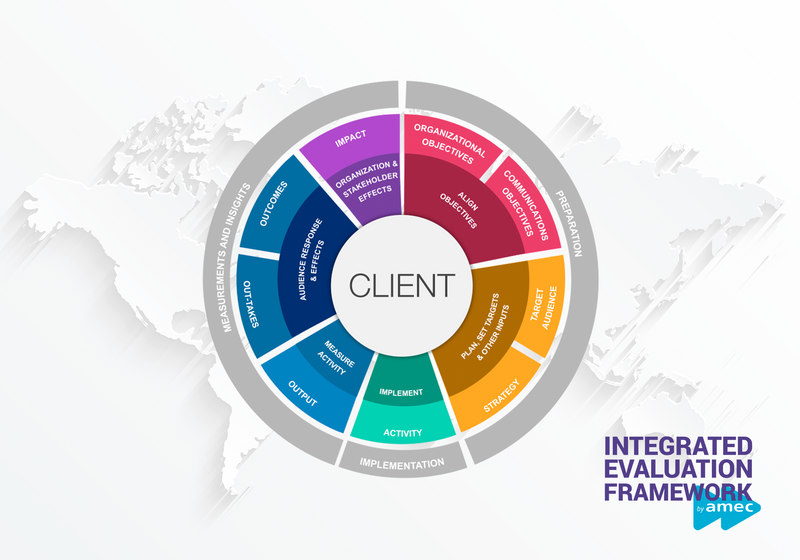
Each November, the communications measurement industry takes part in AMEC’s measurement month (search socials for #amecmm). eMedia Monitor is an active participant in the AMEC community, supporting best practice and education initiatives, sharing our expertise in broadcast and audio-visual monitoring, supporting and speaking at events such as the 2025 AMEC summit in Vienna and AI Day in London.
The AMEC Integrated Evaluation Framework has been adopted globally as an industry standard for best practice communications planning and measurement. Here, we outline how eMedia Monitor’s audio-visual media monitoring solutions help communicators plan and measure campaign effectiveness during each stage of the AMEC Integrated Evaluation Framework – with a lens focused specifically on broadcast communications.
The framework is split into seven stages moving from objectives to impact. Below, we outline practical examples of how eMedia Monitor’s audio-visual media monitoring services can help you make intelligence-led decisions at every stage of this journey – from objectives, inputs, activities, outputs, outtakes, outcomes to impact.
Objectives are the first step on the journey. Communications objectives should take into consideration the overarching organizational objectives too – which could range from sales, fundraising, policy change, behaviour change or voting intention.
Communications objectives should ideally be SMART – specific, measurable, achievable, realistic and time-bound. Example objectives for broadcast activity could include:
Before objectives are even set, it is important to understand what the baseline or benchmark is, so that improvements can be quantified. It would be hard to demonstrate if a communications campaign had ‘increased prime-time TV mentions among national news programmes by 30% in Q1’ without knowing the baseline ‘normal’ level of broadcast exposure. Similarly, without knowing what your broadcast share of voice is against competitors prior to a campaign, it is hard to demonstrate if share of voice increased.
This is where broadcast media monitoring can help. Our archive can help you to look back in time, our real time alerts keep you informed of broadcast mentions as they happen, providing you the data driven context enabling you look to the future and decide on what the achievable objectives should be.
The second stage of the AMEC Integrated Evaluation Framework is inputs. These are the resources and information needed or available in advance of a communication program, including situation analysis, target audience identification, and the necessary resources for activation or execution.
Broadcast monitoring can support with situation analyses - you can plan smarter broadcast campaigns by exploring which channels are most likely to talk about your topic or convey your key messages. For example, imagine you are a PR manager at an NGO tasked with landing national TV coverage for your upcoming sustainability report; you are specifically targeting a late evening news program with a strong audience among policy and governmental decision makers.
Broadcast monitoring can be used strategically to explore how this influential news program has covered issues related to sustainability before, and how other organizations have framed their messaging around sustainability specifically for this audience. These techniques can help the PR manager better understand how their messaging will land with the TV news presenter lined up to interview their spokesperson on the topic.
The third stage is activities. Organizations receive broadcast exposure through a range of communications and marketing related activities. On the paid side, there is advertising. eMedia Monitor’s broadcast monitoring can differentiate between advertisements and programming, meaning that our services can be used by both the marketing and media relations teams.
There are other ways in which organizations can achieve ‘earned’ broadcast exposure – from press releases or press conferences, to surveys, stunts and spokesperson comment.
Broadcast channels can use live or pre-recorded content. In markets such as the UK, radio days are a common activity, providing a spokesperson opportunity to speak with a broad range of national and local radio stations in a short space of time. Sponsorship activity, particularly sports sponsorship, can lead to broadcast exposure often on an international scale. Product placement is also becoming an increasingly effective marketing technique.
eMedia Monitor’s unrivalled speech to text technology will pick up instances where your brand, organization or keyword is spoken – and our image recognition technology is used by many leading organizations who invest in sponsorship – helping you keep track of results from the full range of broadcast related activities you may be using in your communications toolkit.
The fourth stage of the AMEC integrated evaluation framework is outputs – the tangible products of the communication efforts, including the media coverage achieved as a result of these efforts. Outputs represent what is delivered to the audience but do not measure the audience’s response or engagement – if outputs represent what people see (or in the case of radio / audio, what they hear), then the next two stages of the framework which are outtakes and outcomes, represent what the audience thinks and does as a result of being exposed to the communications.
Outputs are the units of content which we serve up to you via our API, real time alerts or which are visible in our DART interface. Outputs include the underlying metadata which sits alongside every broadcast hit – these include temporal markers such as date and time aired, channel or TV/radio station, airtime, country/ geography and reach. Our low latency technology means that during a crisis or important event, you can be informed of broadcast mentions almost as they happen via our real time alerts.
In 2025, we spoke with crisis communications expert Amanda Coleman about her experience heading the communications for Greater Manchester Police in the UK at the time of the Manchester Arena bombing and learned how police forces gather evidence from broadcast outputs to assess what is or isn’t in the public domain, which can prove important during criminal proceedings. This is an example where broadcast monitoring can support public sector and governmental organisations.
If outputs are broadly defined as the things which audiences see (or hear, or experience) as a result of communications activities, then outtakes can be described as what they think or feel. This can require external data sources such as attitudinal or survey data to explore audience sentiment or message recall.
Another way to guide stakeholders on likely audience outtakes from broadcast exposure is to qualitatively assess the dynamics of the coverage received. What were the topics covered in the broadcast? What key messages were conveyed? Was the broadcast positive or negative? eMedia Monitor’s AI powered qualitative analysis tools can help your organization assess these qualitative attributes at scale. Alternatively, if you prefer human insight over artificial intelligence, our export and API functionality, coupled with the quality of our broadcast transcripts make qualitative human-led analysis easy.
Above, we explained how a PR manager at an NGO used broadcast monitoring strategically at the inputs stage to assess how well sustainability related messaging was landing in an influential late night national news program - in order to target the program effectively with messaging which would cut through. The NGO can also use monitoring post-campaign to assess which messages eventually to cut through.
Media monitoring and measurement becomes supercharged when outputs are linked to outcomes. Outcomes can be defined as the things which people do as a result of being exposed to communications.
You may have noticed some organizations using internet search as a call to action in their TV and radio advertising. The UK’s British Heart Foundation is currently running a TV ad campaign with the strapline ‘search BHF wills’. This paid activity may have led to the spikes in Google search visible via Google Trends in mid-August, late September / early October and again in late October.
The British Army is another example of an organization using search as an outcome metric for its paid broadcast campaigns - its recruitment division encouraged audiences to ‘search Army jobs’ as part of its ‘You Belong Here’ campaign. TV, radio and cinema advertising can be run on both a national and regional scale in many countries. The British Army was able to explore correlations between adverts aired, search activity and ultimately whether this had an effect on local recruiting numbers.
Structured data outputs from eMedia Monitor, via the API or within our DART platform using its export functionality, make it easy for you to combine our broadcast information with other data sources which can demonstrate outcomes - whether this be internet search, social media engagement, event registrations or hits to a website.
Impact metrics loop us back towards the beginning of the journey - the organizational objectives. If your organization is a manufacturer of goods, the impact metric might be: did you sell more stuff? If you work for a higher education institution, the impact might be: did you maintain or build student registrations domestically or overseas? If you are a political party the impact might be did you receive the votes you needed to take or maintain power?
The impact stage of the AMEC Integrated Evaluation Framework typically requires additional datasets, which often sit deep inside your organization and sometimes require collaboration with other departments - this could be sales data, share price performance, voting intention or health outcomes. Our Data Cubes for Business Intelligence link your internal business data with eMM media data sets to recognize movements and correlations in your business.
Our unique 10-year monitoring database is the basis of this innovative business intelligence solution. After our metadata has run through different steps such as semantic processing, we accumulate and prepare the Data Cubes before making them available to our customers. The data can then be used via any standard business intelligence software to create relationships between the different internal data bases (revenue, production, CRM) to provide valuable insights with limitless possibilities.
Coca-Cola’s iconic Share a Coke campaign launched almost 15 years ago; the brand relaunched the initiative in 2025, and this time around will no doubt focus on the social shareability of its personalised packaging. Last time around, Coca-Cola carried out deep correlation analysis between its broadcast exposure (both paid and earned) and found that sales spiked notably when the product appeared on local morning TV, demonstrating the ways in which broadcast monitoring can help in making connections back to commercial impact.
If this journey along the AMEC Integrated Framework, when viewed through a broadcast lens, has inspired you to explore how broadcast media monitoring can help your organization at all stages of the communication planning and measurement cycle get in touch:
You might also be interested in:
eMedia Monitor Wins Gold at AMEC Communication Effectiveness Awards 2025
eMM Driving Innovation as the Headline Sponsor of the 2025 AMEC Global Summit in Vienna